The New Colossus
The poem was written for a fundraiser — then it almost disappeared
Emma Lazarus wrote “The New Colossus” on 2 November 1883. She did not write it as a caption for a famous statue already standing in the harbor. She wrote it because someone asked her to help pay for the pedestal.
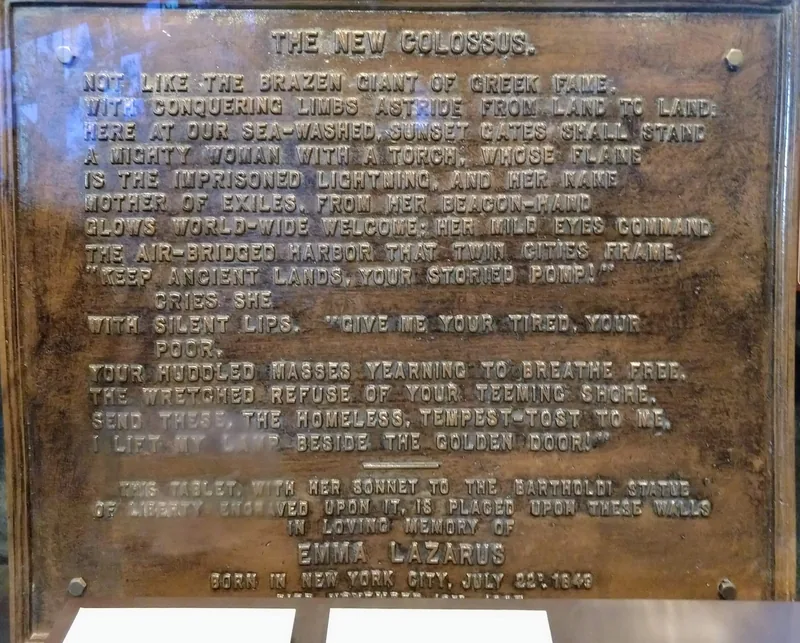
Lazarus was born on 22 July 1849 in New York City, “to a wealthy sugar refining family of Portuguese Sephardic Jewish descent.” Besides writing, she did charitable work for refugees. At Ward’s Island she “worked as an aide for Jewish immigrants who had been detained by Castle Garden immigration officials.” The Russian Jews she met there, the National Park Service says, influenced her writing. [source]
In 1883, William Maxwell Evarts and the author Constance Cary Harrison asked her to compose a sonnet for the “Art Loan Fund Exhibition in Aid of the Bartholdi Pedestal Fund for the Statue of Liberty.” She wrote “The New Colossus” on 2 November 1883. After the auction, the sonnet appeared in Pulitzer’s New York World and in The New York Times. She died in New York on 19 November 1887, “most likely from Hodgkin’s lymphoma,” and was buried at Congregation Shearith Israel’s Beth Olom Cemetery in Cypress Hills, Queens. [source]
The sonnet names the statue “Mother of Exiles,” and gives her the lines most people now think of as hers: “Give me your tired, your poor, / Your huddled masses yearning to breathe free.” The Park Service prints the poem in full on its New Colossus page. After its first popularity, though, “the sonnet slowly faded from public memory.” [source] [source]
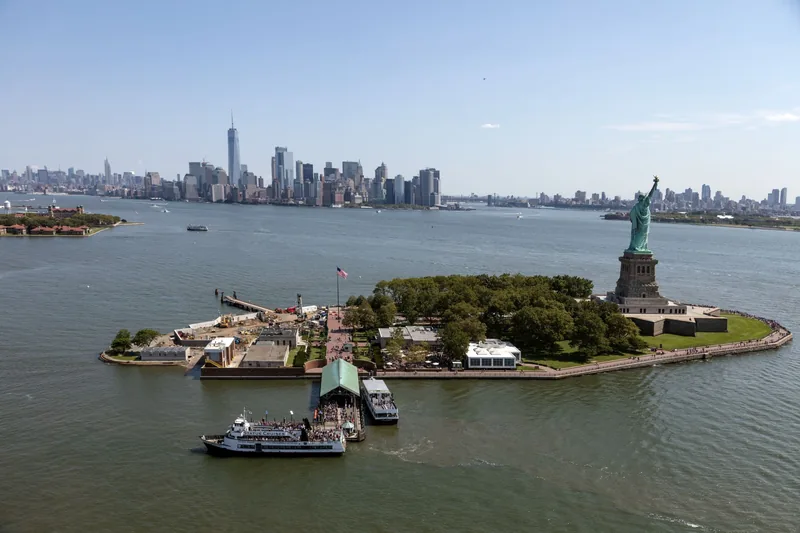
It was not until 1901, “approximately 14 years after Lazarus’s death,” that Georgina Schuyler, a friend of hers, “found a book containing the sonnet in a bookshop and organized a civic effort to resurrect the lost work.” In 1903, words from the sonnet “were inscribed on a plaque and placed on the inner wall of the pedestal of the Statue of Liberty.” Today that 1903 bronze plaque is on display inside the pedestal, and “a replica plaque can be found inside the Statue of Liberty Museum.” [source]
Enjoyed the statue?
No pop-ups. No intrusive advertising. Just interesting stuff. A little support helps the next landmarks site get built.