The torch desk
Open a drawer
The closed torch, a gold replacement flame, a sonnet found in a bookshop, a newspaper that finished the pedestal, a canvas over the statue’s face, Love Island, and the first ticker-tape parade.
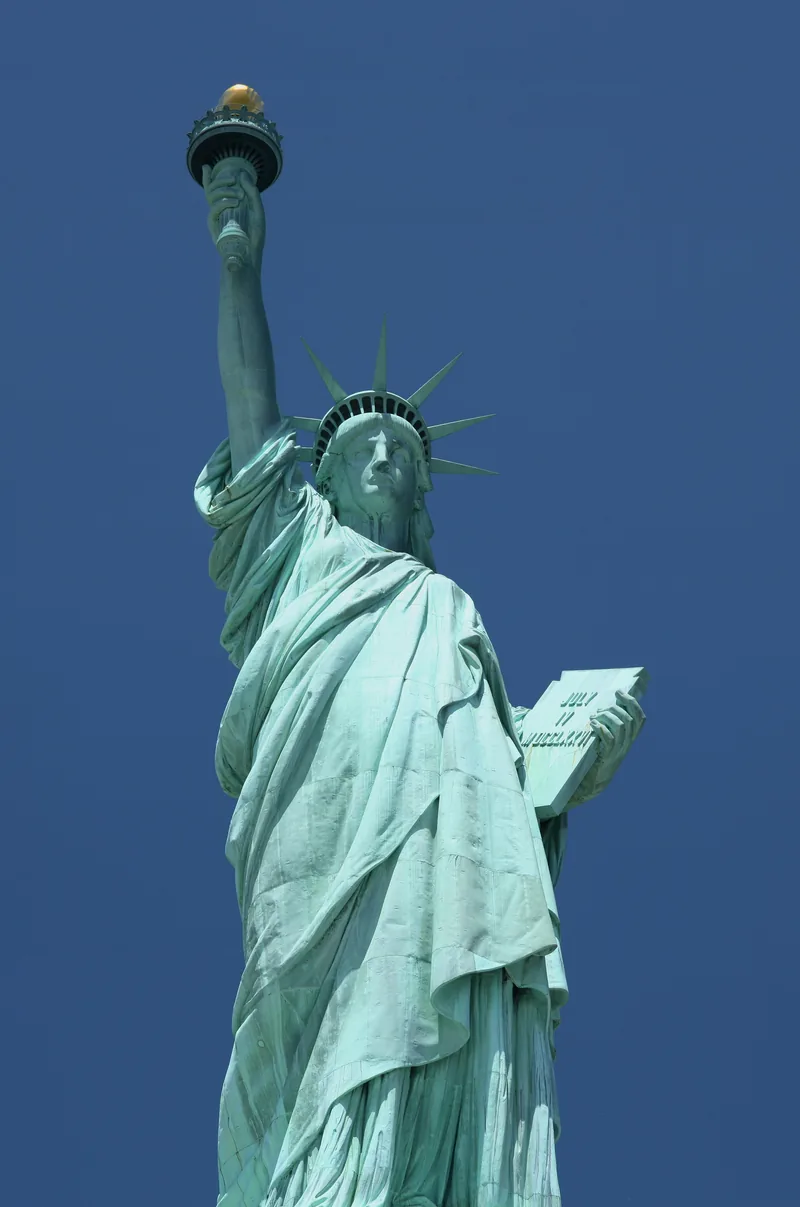
Open a drawer to look closer at the torch, the poem, the pedestal money, a canvas over the statue’s face, and a harbor island that was briefly called Love Island.
The torch has been closed since 1916
The National Park Service’s frequently asked questions are blunt: “Is the torch open?” “The torch has been closed since the ‘Black Tom’ explosion of July 30, 1916, which was one of the largest acts of sabotage to our nation prior to the event of Pearl Harbor on December 7, 1941.” Many visitors, the same page says, confuse the climb to the crown with a visit to the torch. Park staff still climb “a narrow 40ft. ladder in order to maintain the floodlights that light the torch.” [source]
The flame you see now is a 1986 replacement
The current torch “was a replacement of the original and installed in 1986.” It is “copper, covered in 24k. gold leaf.” The original torch was removed in 1984, stood for a time in the pedestal lobby, and in 2018 was moved to the Torch Gallery in the Statue of Liberty Museum. At night the new flame is lit by 16 LED floodlights, the Park Service says; by day it catches the sun. [source] [source]
The sonnet faded — then a friend found it in a bookshop
Emma Lazarus wrote “The New Colossus” on 2 November 1883, for an art-and-literary auction in aid of the pedestal. After a first burst of print, the sonnet “slowly faded from public memory.” It was not until 1901, about fourteen years after her death, that her friend Georgina Schuyler “found a book containing the sonnet in a bookshop and organized a civic effort to resurrect the lost work.” In 1903 words from the sonnet were inscribed on a plaque and placed on the inner wall of the pedestal. [source]
The newspaper of the masses finished the pedestal
When the American Committee ran out of funds for the pedestal, Joseph Pulitzer’s New York World asked ordinary readers to finish the job. “Let us not wait for the millionaires to give us this money. It is not a gift from the millionaires of France to the millionaires of America, but a gift of the whole people of France to the whole people of America.” By 11 August 1885 the World had collected over $100,000, most donations about a dollar or less. Roughly 125,000 people contributed, and the paper printed the name of each one. [source]
A heavy canvas spoiled the view
On 20 October 1886, eight days before the dedication, “a heavy canvas is dropped over the Statue’s face in preparation for the inaugural celebration. Although this spoils the view for many early visitors, the mask stays on until the Statue’s unveiling.” The statue itself was completed on 23 October. The remaining fingers clasping the torch handle had been installed only on the 15th. [source]
The island was briefly called Love Island
In 1667 Isaac Bedloe, a Dutch colonist, obtained ownership of Oyster Island. In 1670 Colonial Governor Francis Lovelace granted him the land, “noting Bedloe’s desire to rename the island to ‘Love Island.’” In 1673 Bedloe died, Lovelace was overthrown by the Dutch navy, “and Love Island is renamed Bedloe’s Island.” The name Liberty Island arrived much later, in 1956, by a joint resolution of Congress signed by President Dwight D. Eisenhower. [source]
The first ticker-tape parade was hers
On 28 October 1886, New York City “holds the first Ticker-Tape Parade in honor of the dedication of the statue of ‘Liberty Enlightening the World’ which over one million people attend.” A water parade of about 300 vessels passed in front of the statue, “even though visibility is less than a quarter of a mile due to fog and rain throughout the day.” [source]
Keep exploring
Enjoyed the statue?
No pop-ups. No intrusive advertising. Just interesting stuff. A little support helps the next landmarks site get built.