History
From a French idea to a gold flame in New York Harbor
The statue did not arrive complete, and the island did not always have her name. The story runs from a proposal in 1865 to a newspaper campaign, a year in storage, a foggy dedication day, a closed torch, and a centennial restoration.
In 1865, Édouard de Laboulaye, “a French political intellectual and authority on the U.S. Constitution,” proposed that France give a statue representing liberty to the United States for its centennial. The Union victory in the Civil War, the National Park Service chronology says, “reaffirms the United States’ ideals of freedom and democracy.” Bartholdi “enthusiastically supports Laboulaye’s proposed statue and becomes the sculptor.” In 1871 he came to the United States to promote the project and look for a site. He came back reporting “the perfect site — Bedloe’s Island located in New York Harbor.” [source]
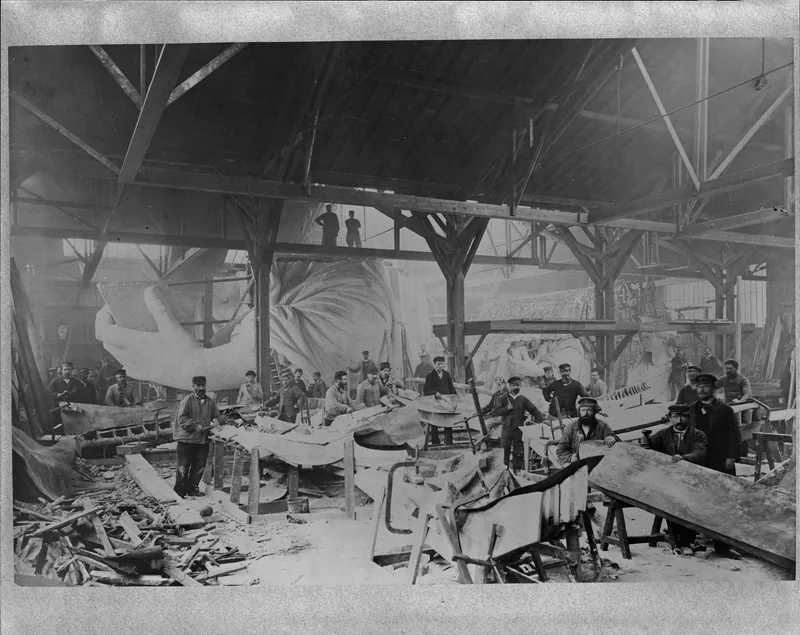
Construction in France began in 1876. The arm holding the torch was shown that year at the Centennial Exposition in Philadelphia; the head and shoulders were displayed at the Paris Universal Exposition in 1878. In 1879 the statue’s first engineer, Eugène Viollet-le-Duc, died, and Bartholdi hired Alexandre-Gustave Eiffel “to complete the project and overcome various obstacles concerning the Statue’s structure and assembly.” The entire statue was completed and assembled in Paris between 1881 and 1884, and presented on 4 July 1884 to Levi P. Morton, the U.S. minister to France. [source] [source]
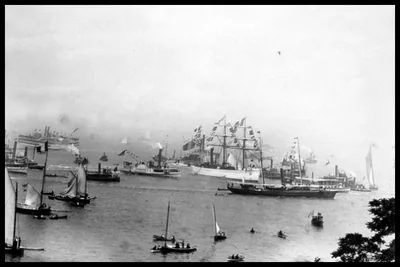
She crossed the Atlantic aboard the French navy ship Isère and arrived in New York Harbor on 17 June 1885, “met with tremendous fanfare and a naval parade, but is placed in storage for a year while the pedestal is completed.” Funds for that pedestal had run out. Joseph Pulitzer’s New York World then raised over $100,000 in six months, from roughly 125,000 people, most of them giving a dollar or less. [source] [source]
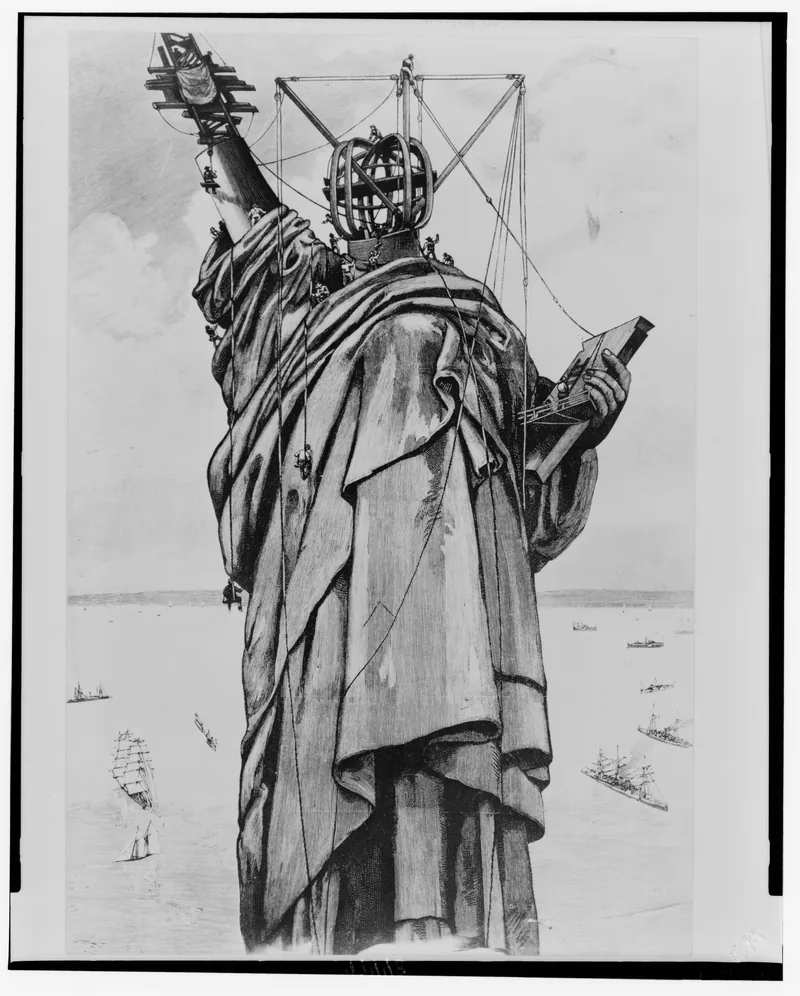
On the island, “the first piece of the Statue to be reconstructed was Alexandre-Gustave Eiffel’s iron framework.” The rest followed “without the use of scaffolding — all construction materials were hoisted up by steam-driven cranes and derricks.” Fort Wood “became a part of the Statue’s base — the pedestal sits within its walls.” On 20 October 1886 a heavy canvas was dropped over the statue’s face. It stayed there until the unveiling, and spoiled the view for early visitors. [source] [source]
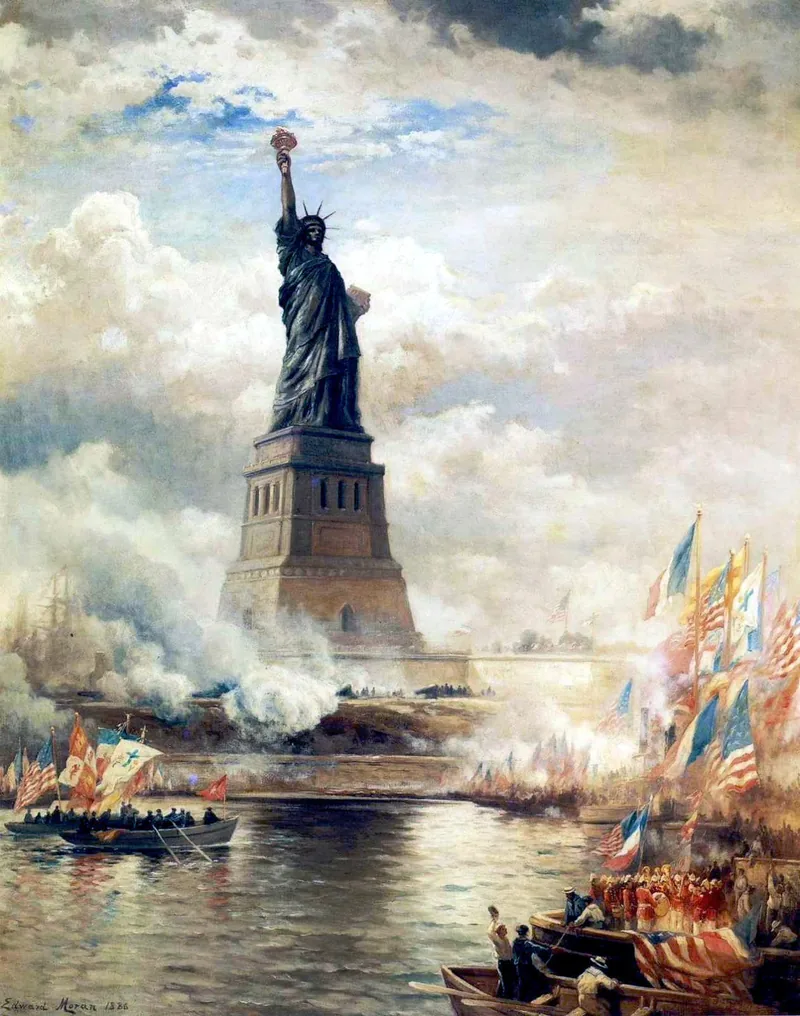
On 28 October 1886, New York held “the first Ticker-Tape Parade” for the dedication, “which over one million people attend.” About 300 vessels passed in front of the statue, “even though visibility is less than a quarter of a mile due to fog and rain throughout the day.” President Grover Cleveland accepted the statue on behalf of the United States. Edward Moran’s painting of that day is a picture of the occasion, not a photograph of it. [source]
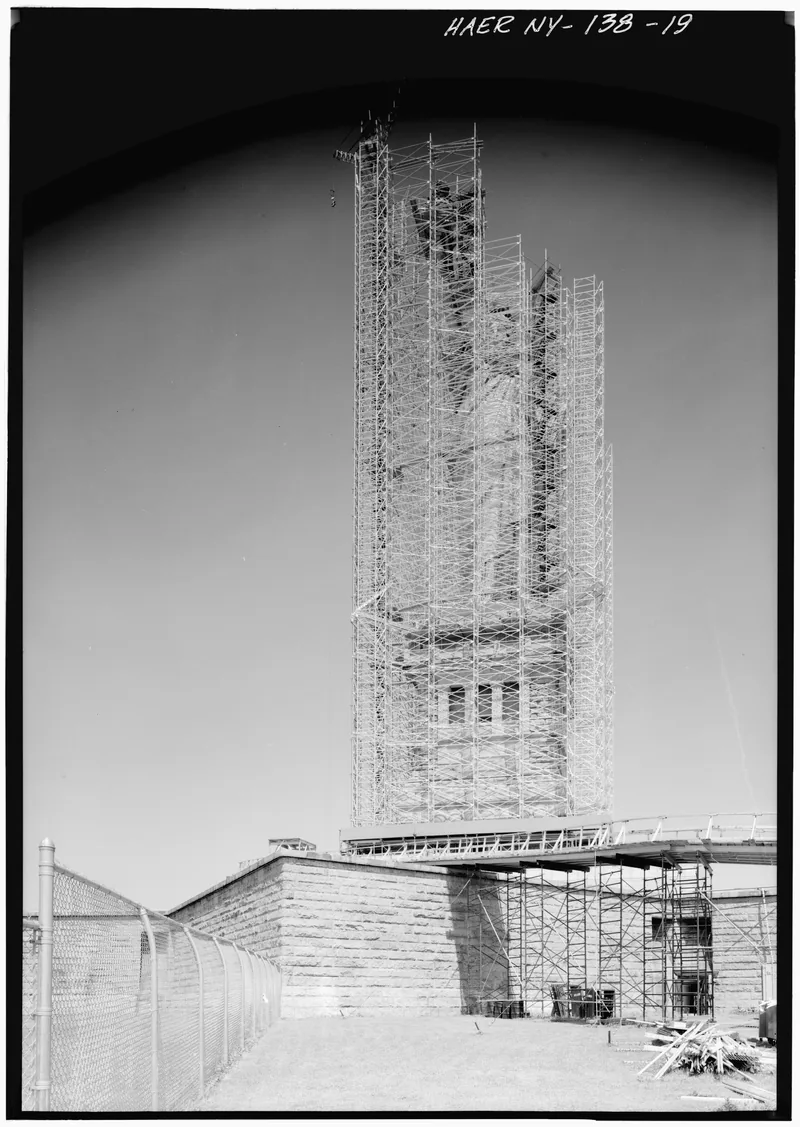
Later years changed how she was kept, and who kept her. In 1924 President Calvin Coolidge designated the statue a national monument. In 1933 care passed to the National Park Service. In 1956 Bedloe’s Island was renamed Liberty Island. In 1984, as restoration began, the United Nations designated the statue a World Heritage Site. Fundraising for the 1980s work, a public-private partnership, was for $86 million. Scaffolding went up in 1984; rusted iron armature bars were replaced with stainless steel; the damaged flame was replaced and gilded “according to Bartholdi’s original plans.” The newly restored statue opened on 5 July 1986, during Liberty Weekend. [source] [source] [source]
Keep exploring
Enjoyed the statue?
No pop-ups. No intrusive advertising. Just interesting stuff. A little support helps the next landmarks site get built.