Myths versus facts
What people assume, and what the record says
Some of the most common stories about the statue are tidy, and wrong. Others are almost right, but the official pages are more particular than the version that travels.
- Myth: Visitors can go up into the torch.
- Fact: “The torch has been closed since the ‘Black Tom’ explosion of July 30, 1916.” People who think they have been in the torch have usually climbed to the crown. [source]
- Myth: The gold flame is original.
- Fact: The current torch “was a replacement of the original and installed in 1986.” It is copper covered in 24-karat gold leaf. The original torch was removed in 1984 and is now in the Statue of Liberty Museum. [source] [source]
- Myth: Emma Lazarus wrote the poem for the unveiling.
- Fact: She wrote “The New Colossus” on 2 November 1883, three years before the dedication, for an art-and-literary auction in aid of the pedestal fund. [source]
- Myth: The poem has always been on the statue.
- Fact: After Lazarus’s death the sonnet “slowly faded from public memory.” Georgina Schuyler found it in a bookshop in 1901. The pedestal plaque dates from 1903. [source]
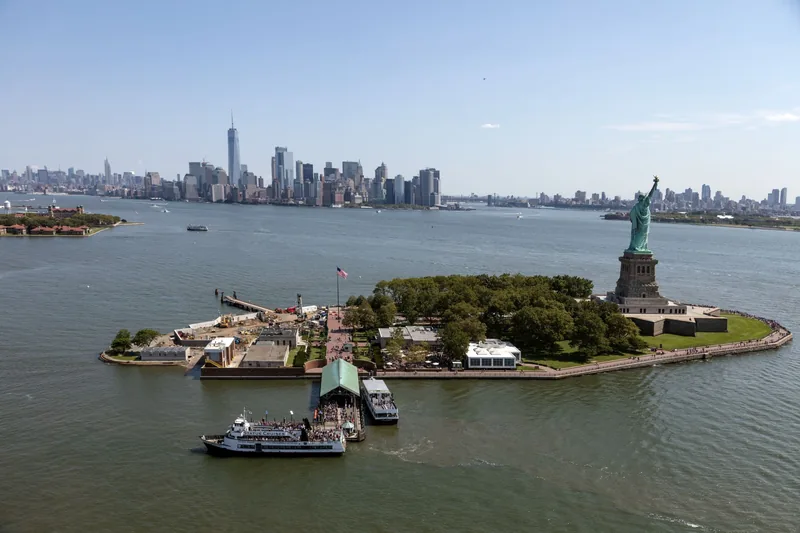
- Myth: The statue stands on Ellis Island.
- Fact: “The Statue of Liberty is located on Liberty Island,” the frequently asked questions page says. “It is not located on Ellis Island.” [source]
- Myth: Liberty Island has always had that name.
- Fact: The island has been called Oyster Island, Love Island and Bedloe’s Island. It was renamed Liberty Island in 1956 by a joint resolution of Congress, signed by President Eisenhower. [source]
- Myth: She was assembled on the island from the start.
- Fact: She was completed and assembled in Paris, presented there on 4 July 1884, taken apart, shipped on the Isère, stored for a year, and only then rebuilt on Bedloe’s Island. [source] [source]
- Myth: Millionaires paid for the pedestal.
- Fact: The American Committee raised $125,000 between 1877 and 1884, then ran out of money. Pulitzer’s campaign raised over $100,000 from roughly 125,000 people, most giving a dollar or less. [source] [source]
- Myth: You have to pay to enter Liberty Island itself.
- Fact: “There is no entrance fee for Liberty and Ellis Islands as they are fee-exempt by law.” The ferry is a separate transportation fee. [source]
- Myth: The copper was painted green.
- Fact: “The copper turned green naturally due to oxidation.” The sheeting is 3/32 of an inch thick, “the thickness of two pennies placed together.” [source] [source]
- Myth: The first illumination and the closed torch are the same 1916 event.
- Fact: The chronology says the statue “is illuminated for the first time” in 1916. The frequently asked questions page dates the torch closing to the Black Tom explosion of 30 July 1916. Those are two official statements, and this site does not treat them as one story. [source] [source]
- Myth: Eiffel designed the statue’s appearance.
- Fact: Bartholdi was the sculptor. Eiffel and Company engineered the statue, after Viollet-le-Duc’s death in 1879. Hunt designed the pedestal. [source] [source]
Keep exploring
Enjoyed the statue?
No pop-ups. No intrusive advertising. Just interesting stuff. A little support helps the next landmarks site get built.