Discoveries
Things you might not know about the Statue of Liberty
An island once called Love Island, a canvas over the statue’s face, the first ticker-tape parade, a sonnet found in a bookshop, and a torch closed since 1916.
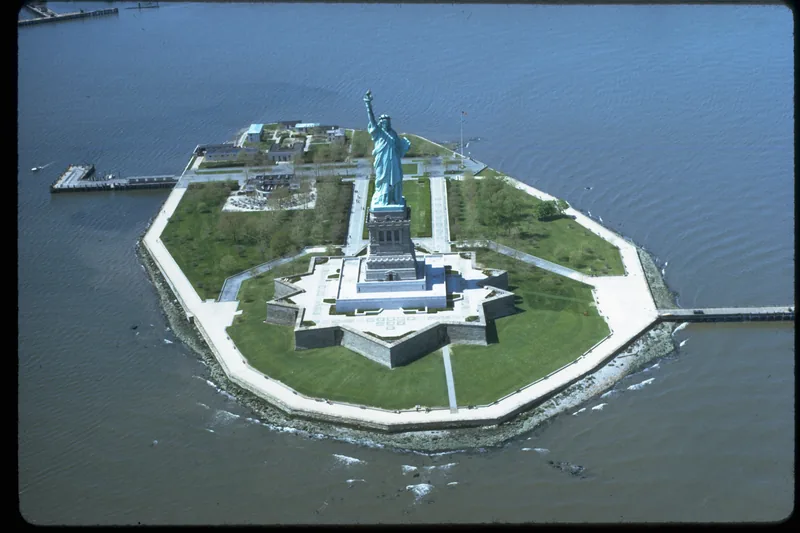
She stands inside a star-shaped fort
Fort Wood is an “11-point star fort” that “aids in the protection of the New York Harbor.” It was completed in 1811 as the “Works on Bedloe’s Island,” and renamed in 1814 by New York Governor Daniel D. Tompkins “in the memory of Eleazer D. Wood, an army hero killed in action at Fort Erie.” The pedestal sits within its walls. [source] [source]
The island was briefly called Love Island
Isaac Bedloe obtained Oyster Island in 1667. In 1670 Governor Lovelace noted Bedloe’s desire to rename it “Love Island.” In 1673, after Bedloe’s death and a Dutch overthrow of Lovelace, “Love Island is renamed Bedloe’s Island.” The name Liberty Island arrived only in 1956. [source]
Eiffel was the second engineer, not the first
In 1879 Eugène Viollet-le-Duc died, and Bartholdi hired Alexandre-Gustave Eiffel to finish the structural work. When the statue was rebuilt on the island, “the first piece of the Statue to be reconstructed was Alexandre-Gustave Eiffel’s iron framework.” [source] [source]
She spent a year in storage
The Isère arrived on 17 June 1885 to “tremendous fanfare and a naval parade,” but the statue “is placed in storage for a year while the pedestal is completed.” [source]
Ordinary readers finished the pedestal
Pulitzer’s World raised over $100,000 in six months, most donations about a dollar or less, from roughly 125,000 people, and printed each name. “It is not a gift from the millionaires of France to the millionaires of America, but a gift of the whole people of France to the whole people of America.” [source]
A heavy canvas covered her face
On 20 October 1886, “a heavy canvas is dropped over the Statue’s face in preparation for the inaugural celebration. Although this spoils the view for many early visitors, the mask stays on until the Statue’s unveiling.” [source]
The first ticker-tape parade was hers
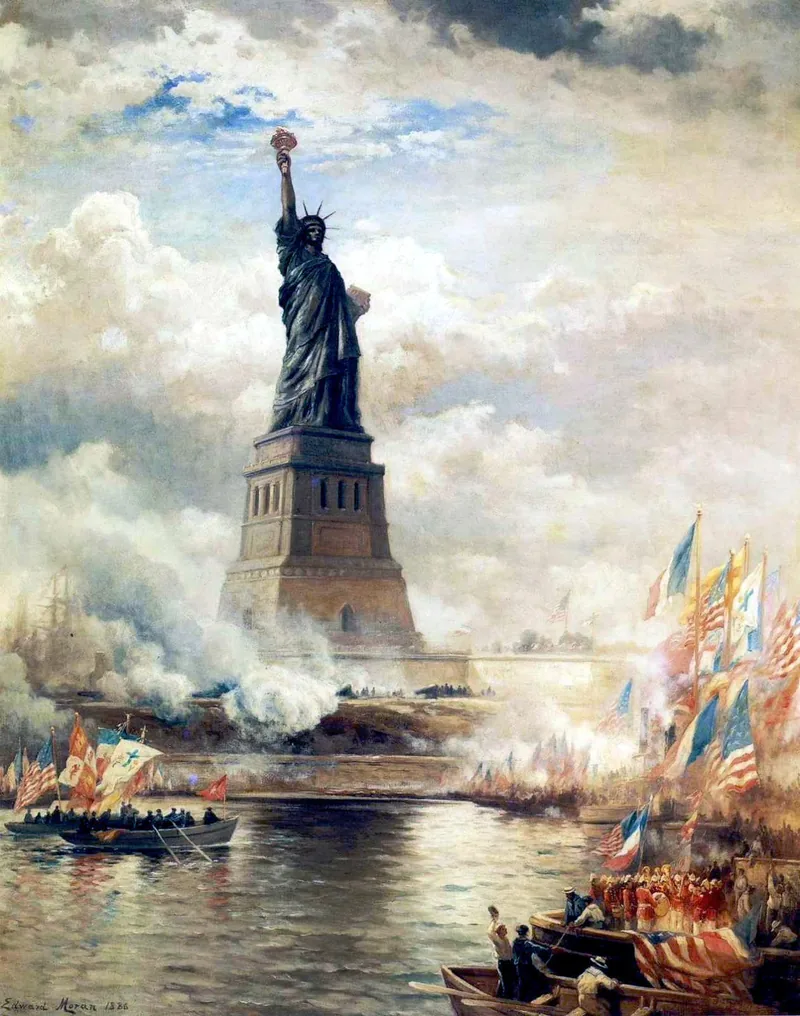
On dedication day, 28 October 1886, New York “holds the first Ticker-Tape Parade,” attended by over one million people. A water parade of about 300 vessels passed in front of the statue in fog and rain, with visibility “less than a quarter of a mile.” [source]
The famous poem almost vanished
Lazarus’s sonnet faded from public memory after her death. In 1901 Georgina Schuyler found it in a bookshop and organized a civic effort to bring it back. The pedestal plaque dates from 1903. [source]
The torch has been closed since 1916
“The torch has been closed since the ‘Black Tom’ explosion of July 30, 1916.” Visitors who think they have been in the torch, the Park Service says, have usually climbed to the crown instead. [source]
The flame you see is a 1986 replacement
The original torch was removed in 1984 and is now in the Statue of Liberty Museum. The current torch is copper covered in 24-karat gold leaf, and is lit at night by 16 LED floodlights. [source] [source]
The copper is as thin as two pennies
The sheeting is “3/32 of an inch, the thickness of two pennies placed together.” “The copper turned green naturally due to oxidation.” [source] [source]
Broken shackles lie at her feet
The facts page is plain about the symbolism: the torch represents enlightenment; the tablet reads 4 July 1776; “Broken shackles and chains lie at her feet, symbolizing the abolition of slavery.” [source]
She was, for a time, a lighthouse
On 10 October 1886, President Cleveland placed the statue and pedestal under the U.S. Lighthouse Board “as maritime structures.” The Army Corps of Engineers had vetoed flood lights on the torch’s balcony, so Bartholdi “cuts portholes in the torch and put lights inside of them.” [source]
The crews who reassembled her were mostly immigrants
The 1886 chronology is specific: the American Committee signed a contract with D.H. King of New York, and “the crews, most of whom are immigrants, assemble the Statue with great precision and speed.” [source]
Keep exploring
Enjoyed the statue?
No pop-ups. No intrusive advertising. Just interesting stuff. A little support helps the next landmarks site get built.