Fact file
98 sourced facts about the Statue of Liberty
Each line is taken from an official National Park Service page, or from a named photograph file. Where two official pages give slightly different figures, both are kept, and neither is rewritten into the other.
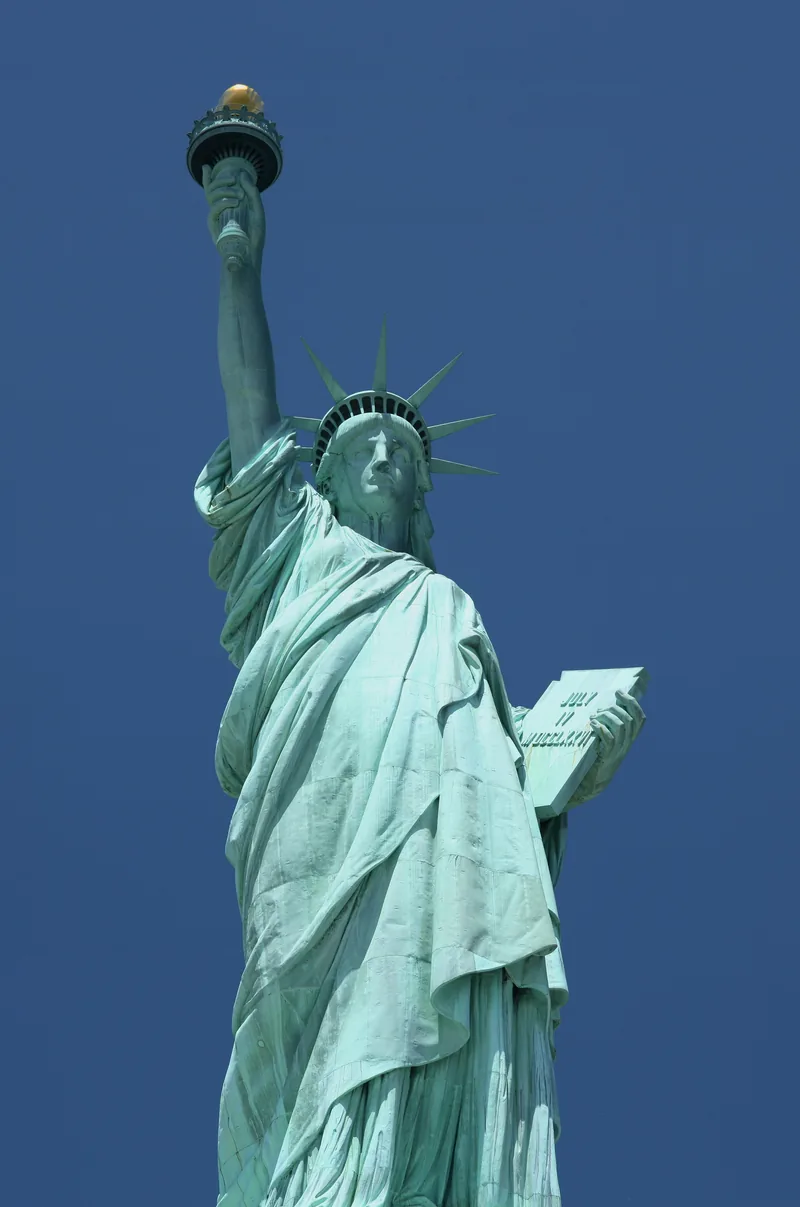
- The official name is La Liberté éclairant le monde, “Liberty Enlightening the World.” [source]
- The statue was officially dedicated on 28 October 1886. [source]
- Location: Liberty Island, New York Harbor. [source]
- French thinker Édouard de Laboulaye and sculptor Frédéric Auguste Bartholdi proposed the gift “to celebrate the centennial of the United States, the end of the American Civil War, and friendship between the United States and France.” [source]
- The official designers are Bartholdi (sculptor), Richard Morris Hunt (pedestal architect), Eiffel and Company (statue engineer), and General Charles P. Stone (pedestal engineer). [source]
- In 1865 Laboulaye proposed a statue representing liberty as a gift for the U.S. centennial. [source]
- Bartholdi “enthusiastically supports Laboulaye’s proposed statue and becomes the sculptor.” [source]
- In 1871 Bartholdi travelled to the United States “to promote the statue and determine the site.” [source]
- In 1872 he reported “the perfect site — Bedloe’s Island located in New York Harbor.” [source]
- Construction in France began in 1876, according to the creating page. The facts page dates construction in France from 1875 to 1884. Both official dates are kept here. [source] [source]
- The arm holding the torch was exhibited at the 1876 Centennial Exposition in Philadelphia. [source]
- The head and shoulders were displayed at the Paris Universal Exposition in 1878. [source]
- In 1879 engineer Eugène Viollet-le-Duc died, and Bartholdi hired Alexandre-Gustave Eiffel. [source]
- The entire statue was completed and assembled in Paris between 1881 and 1884. [source]
- On 4 July 1884 the statue was presented in Paris to Levi P. Morton, the U.S. minister to France. [source]
- The statue was shipped to the United States aboard the French navy ship Isère. [source]
- She arrived in New York Harbor on 17 June 1885. [source]
- She was “placed in storage for a year while the pedestal is completed.” [source]
- The American Committee, chaired by William Maxwell Evarts, “raises $125,000 between 1877 and 1884.” [source]
- When those funds ran out, Pulitzer’s New York World launched a six-month campaign and collected over $100,000. [source]
- Roughly 125,000 people contributed to Pulitzer’s campaign, “with most donations being a dollar or less.” [source]
- The paper printed the name of every contributor. [source]
- Pulitzer’s appeal of 16 March 1885 said the statue “is not a gift from the millionaires of France to the millionaires of America, but a gift of the whole people of France to the whole people of America.” [source]
- Richard Morris Hunt’s pedestal has poured concrete walls “up to 20 feet thick, faced with granite blocks,” and was described as “the largest mass of poured concrete at that time.” [source]
- The foundation is 15 feet deep. [source]
- General Charles P. Stone was appointed chief engineer in 1883 and was responsible for the foundation and pedestal construction. [source]
- “The first piece of the Statue to be reconstructed was Alexandre-Gustave Eiffel’s iron framework.” [source]
- Reassembly used “no scaffolding — all construction materials were hoisted up by steam-driven cranes and derricks.” [source]
- Fort Wood “became a part of the Statue’s base — the pedestal sits within its walls.” [source]
- In April 1886 the American Committee signed a contract with D.H. King of New York to complete the work. [source]
- The 1886 crews, “most of whom are immigrants,” assembled the statue “with great precision and speed.” [source]
- On 10 October 1886 President Cleveland placed the statue and pedestal under the U.S. Lighthouse Board “as maritime structures.” [source]
- The Army Corps of Engineers vetoed flood lights on the torch balcony, so Bartholdi “cuts portholes in the torch and put lights inside of them.” [source]
- On 15 October 1886 the remaining fingers clasping the torch handle were installed. [source]
- On 20 October 1886 “a heavy canvas is dropped over the Statue’s face,” spoiling the view for early visitors until the unveiling. [source]
- The statue was completed on 23 October 1886. [source]
- On 28 October 1886 New York “holds the first Ticker-Tape Parade,” which “over one million people attend.” [source]
- A water parade of about 300 vessels passed in front of the statue, “even though visibility is less than a quarter of a mile due to fog and rain.” [source]
- President Grover Cleveland formally accepted the statue on behalf of the United States. [source]
- Emma Lazarus was born on 22 July 1849 in New York City, “to a wealthy sugar refining family of Portuguese Sephardic Jewish descent.” [source]
- She worked at Ward’s Island “as an aide for Jewish immigrants who had been detained by Castle Garden immigration officials.” [source]
- She wrote “The New Colossus” on 2 November 1883 for the “Art Loan Fund Exhibition in Aid of the Bartholdi Pedestal Fund for the Statue of Liberty.” [source]
- The sonnet later appeared in the New York World and The New York Times. [source]
- Lazarus died in New York on 19 November 1887, “most likely from Hodgkin’s lymphoma.” [source]
- She is buried at Congregation Shearith Israel’s Beth Olom Cemetery in Cypress Hills, Queens, New York. [source]
- After her death the sonnet “slowly faded from public memory.” [source]
- In 1901 her friend Georgina Schuyler “found a book containing the sonnet in a bookshop and organized a civic effort to resurrect the lost work.” [source]
- In 1903 words from the sonnet “were inscribed on a plaque and placed on the inner wall of the pedestal.” [source]
- An exact replica of the 1903 bronze plaque is in the Statue of Liberty Museum. [source]
- The sonnet calls the statue “Mother of Exiles.” [source]
- Official height of the statue: 151 feet, 1 inch (46.05 m). [source]
- Official height of the pedestal: 154 feet (46.93 m). [source]
- From the ground to the tip of the torch: 305 feet, 1 inch (92.9894 m). [source]
- That height is “the equivalent height of a 22-story building.” [source]
- In 1886 “it was the tallest structure in New York.” [source]
- From the ground, visitors climb 377 steps to reach the crown. [source]
- The crown has 25 windows and seven rays. [source]
- The tablet in the left arm is inscribed “JULY IV MDCCLXXVI.” [source]
- The torch in the right hand represents enlightenment. [source]
- “Broken shackles and chains lie at her feet, symbolizing the abolition of slavery.” [source]
- The copper sheeting is “3/32 of an inch, the thickness of two pennies placed together.” [source]
- “The copper turned green naturally due to oxidation.” [source]
- The facts page estimates the statue at 560,000 pounds (254,000 kg), of which 179,200 pounds (81,300 kg) are copper. [source]
- The facts page estimates the pedestal at approximately 52 million pounds (23.59 million kg). [source]
- The statistics page lists copper at 176,000 pounds, the framework at 440,000 pounds, and the concrete foundation at 54,000,000 pounds. Those official figures are kept separate from the facts-page estimates. [source]
- About 3.8 million people visit the Statue of Liberty each year. [source]
- There is no entrance fee for Liberty and Ellis Islands; they are “fee-exempt by law.” The ferry is a separate transportation fee. [source]
- The statue “is on Liberty Island, federal property administered by the National Park Service, located within the territorial jurisdiction of the State of New York.” [source]
- An 1834 compact between New York and New Jersey agreed that the state line would be the middle of the Hudson River, but that New York would retain “exclusive jurisdiction” over the islands in the water. [source]
- “The Statue of Liberty is located on Liberty Island. It is not located on Ellis Island.” [source]
- “The torch has been closed since the ‘Black Tom’ explosion of July 30, 1916.” [source]
- Park staff climb “a narrow 40ft. ladder in order to maintain the floodlights that light the torch.” [source]
- The current torch, installed in 1986, is “copper, covered in 24k. gold leaf.” [source]
- At night the new flame is lit by 16 LED floodlights; by day it is designed to be reflective. [source]
- The original torch was removed in 1984, displayed in the pedestal lobby, and moved in 2018 to the Torch Gallery in the Statue of Liberty Museum. [source] [source]
- Isaac Bedloe obtained Oyster Island in 1667. [source]
- In 1670 Governor Francis Lovelace noted Bedloe’s desire to rename it “Love Island.” [source]
- In 1673, after Bedloe’s death, “Love Island is renamed Bedloe’s Island.” [source]
- The “Works on Bedloe’s Island” were completed in 1811 and renamed Fort Wood in 1814, in memory of Eleazer D. Wood. [source]
- Fort Wood is an “11-point star fort.” [source]
- In 1956 Bedloe’s Island was renamed Liberty Island by a joint resolution of Congress signed by President Dwight D. Eisenhower. [source]
- On 15 October 1924 President Calvin Coolidge designated the statue a National Monument, with the boundary “at the outer edge of Fort Wood.” [source]
- In 1933 the National Park Service assumed responsibility. [source]
- In 1937 jurisdiction was enlarged to all of Bedloe’s Island. [source]
- In 1965 President Lyndon Johnson added Ellis Island to the Statue of Liberty National Monument. [source]
- The first Otis elevator was installed in the pedestal in 1907. [source]
- In 1916 the statue “is illuminated for the first time.” [source]
- In 1918 the first repairs to the copper skin were made. [source]
- In 1982 President Reagan appointed Lee Iacocca to head a private-sector effort; the fundraising was for $86 million. [source] [source]
- In 1984 restoration began, and the United Nations designated the statue a World Heritage Site. [source]
- Rusted iron armature bars were replaced with stainless steel during the 1980s restoration. [source]
- The damaged flame was replaced and gilded “according to Bartholdi’s original plans.” [source]
- In 1985 a shell midden was found during restoration. [source]
- The newly restored statue opened on 5 July 1986, during Liberty Weekend. [source]
- The official centennial was marked on 28 October 1986 with French and U.S. officials present. [source]
- The facts page gives a period cost estimate of $300,000 to $600,000 for the statue and pedestal, roughly $17–22 million today. [source]
- A historic U.S. Army Signal Corps photograph shows Fort Wood with a wooden pier and cannons. The file does not give a precise date. [source]
- Jet Lowe photographed the statue and pedestal in scaffolding in May 1984 for the Historic American Engineering Record. [source]
Keep exploring
Enjoyed the statue?
No pop-ups. No intrusive advertising. Just interesting stuff. A little support helps the next landmarks site get built.